THE IMPACT OF INTELLECTUAL CAPITAL ON COMPANY RESULTS
Detali informacija
Ištrauka
INTRODUCTION
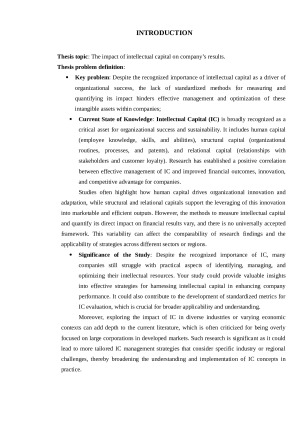
Thesis topic: The impact of intellectual capital on company’s results.
Thesis problem definition:
Key problem: Despite the recognized importance of intellectual capital as a driver of
organizational success, the lack of standardized methods for measuring and
quantifying its impact hinders effective management and optimization of these
intangible assets within companies;
Current State of Knowledge: Intellectual Capital (IC) is broadly recognized as a
critical asset for organizational success and sustainability. It includes human capital
(employee knowledge, skills, and abilities), structural capital (organizational
routines, processes, and patents), and relational capital (relationships with
stakeholders and customer loyalty). Research has established a positive correlation
between effective management of IC and improved financial outcomes, innovation,
and competitive advantage for companies.
Studies often highlight how human capital drives organizational innovation and
adaptation, while structural and relational capitals support the leveraging of this innovation
into marketable and efficient outputs. However, the methods to measure intellectual capital
and quantify its direct impact on financial results vary, and there is no universally accepted
framework. This variability can affect the comparability of research findings and the
applicability of strategies across different sectors or regions.
Significance of the Study: Despite the recognized importance of IC, many
companies still struggle with practical aspects of identifying, managing, and
optimizing their intellectual resources. Your study could provide valuable insights
into effective strategies for harnessing intellectual capital in enhancing company
performance. It could also contribute to the development of standardized metrics for
IC evaluation, which is crucial for broader applicability and understanding.
Moreover, exploring the impact of IC in diverse industries or varying economic
contexts can add depth to the current literature, which is often criticized for being overly
focused on large corporations in developed markets. Such research is significant as it could
lead to more tailored IC management strategies that consider specific industry or regional
challenges, thereby broadening the understanding and implementation of IC concepts in
practice.
This proposed study could not only fill existing gaps in academic literature but also
offer practical guidance for businesses seeking to maximize their intellectual capital in a
rapidly changing global economy.
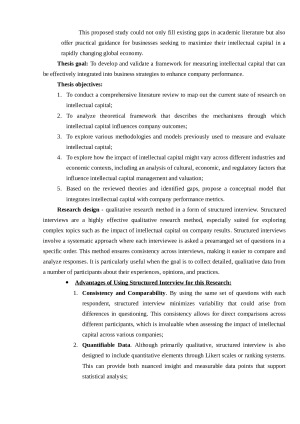
Thesis goal: To develop and validate a framework for measuring intellectual capital that can
be effectively integrated into business strategies to enhance company performance.
Thesis objectives:
1.To conduct a comprehensive literature review to map out the current state of research on
intellectual capital;
2.To analyze theoretical framework that describes the mechanisms through which
intellectual capital influences company outcomes;
3.To explore various methodologies and models previously used to measure and evaluate
intellectual capital;
4.To explore how the impact of intellectual capital might vary across different industries and
economic contexts, including an analysis of cultural, economic, and regulatory factors that
influence intellectual capital management and valuation;
5.Based on the reviewed theories and identified gaps, propose a conceptual model that
integrates intellectual capital with company performance metrics.
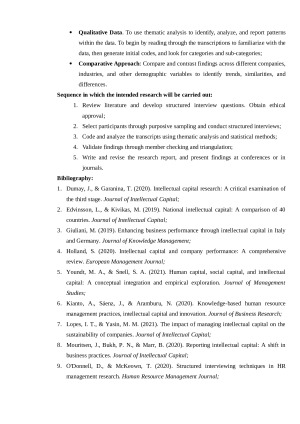
Research design - qualitative research method in a form of structured interview. Structured
interviews are a highly effective qualitative research method, especially suited for exploring
complex topics such as the impact of intellectual capital on company results. Structured interviews
involve a systematic approach where each interviewee is asked a prearranged set of questions in a
specific order. This method ensures consistency across interviews, making it easier to compare and
analyze responses. It is particularly useful when the goal is to collect detailed, qualitative data from
a...
Mūsų mokslo darbų bazėje yra daugybė įvairių mokslo darbų, todėl tikrai atrasi sau tinkamą!

Svetainė naudinga. Visada galima rasti medžiagos ir pritaikyti rašant darbus.

Platus pasirinkimas, didelė pagalba mokantiems ir besimokantiems, leidžia sutaupyti laiką ir pasisemti naujų idėjų. Ačiū

Labai gera svetainė,kai nėra idėjų referatui ši svetainė labai padeda.

Gali rasti naudingos medžiagos. Reikalui esant ją persitvarkyti pagal save. Ačiū

Ačiū, kad esat.Didelis pasirinkimas. Mielai naudojuosi. Labai susitaupo laikas.

Puiki svetainė, gerai, kad yra iš kur pasisemti pavyzdžių, kai galva jau nebeveikia :)