PERCEIVED IRRITATION IN ONLINE SHOPPING EXAMINING THE IMPACT OF VISUAL AND INFORMATIONAL ELEMENTS ON PURCHASE INTENTION BY COMPARING SEARCH AND EXPERIENCE GOODS
Detali informacija
Ištrauka
PERCEIVED IRRITATION IN ONLINE SHOPPING: EXAMINING THE IMPACT OF
VISUAL AND INFORMATIONAL ELEMENTS ON PURCHASE INTENTION BY
COMPARING SEARCH AND EXPERIENCE GOODS
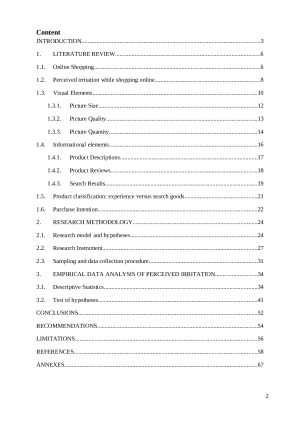
Content
INTRODUCTION 3
1. LITERATURE REVIEW 6
1.1. Online Shopping 6
1.2. Perceived irritation while shopping online 8
1.3. Visual Elements 10
1.3.1. Picture Size 12
1.3.2. Picture Quality 13
1.3.3. Picture Quantity 14
1.4. Informational elements 16
1.4.1. Product Descriptions 17
1.4.2. Product Reviews 18
1.4.3. Search Results 19
1.5. Product classification: experience versus search goods 21
1.6. Purchase Intention 22
2. RESEARCH METHODOLOGY 24
2.1. Research model and hypotheses 24
2.2. Research Instrument 27
2.3. Sampling and data collection procedure 31
3. EMPIRICAL DATA ANALYSIS OF PERCEIVED IRRITATION 34
3.1. Descriptive Statistics 34
3.2. Test of hypotheses 41
CONCLUSIONS 52
RECOMMENDATIONS 54
LIMITATIONS 56
REFERENCES 58
ANNEXES 67
INTRODUCTION
Shopping online has skyrocketed over the last few years (Pasquali, 2023). Such a
breakthrough was influenced by the coronavirus pandemic which has undeniably caused
significant adjustments in selling and buying behaviour (Mohsin, 2022). During the worldwide
natural disaster businesses were forced to close their shops and lockdown restrictions shuttled
consumers to virtual domains (Ang, 2021). To keep up with the business life cycle, companies
were compelled to hasten the digital transition whereas consumers were trying to adapt to the
new normal – online shopping. According to Statista (2023) data, statistics of retail e-commerce
sales worldwide show that by the start of the global pandemic, in 2020, sales jumped nearly 1
billion dollars, which is 21% year-over-year. Moreover, during the whole sanitary crisis, it
continued to grow with sales reaching the number of 5,211 billion dollars in 2021. And while the
incidence of cases has been lowered and restrictions eased, consumer online shopping habits
remained similar as in previous years, and e-commerce managed to thrive even further (5,171
billion dollars in 2022). By the end of 2023, it is predicted that e-commerce will gain 6,310
billion dollars of total sales, which compared to the beginning of the pandemic era is 49% higher
than it used to be (Statista, 2023).
Due to significant online shopping growth and high competition, every e-commerce
brand tries to differentiate itself from others. Several companies focus on customer services,
some invest in marketing channels, others choose to engage their consumers with loyalty
programs and the rest use other strategy tools. However, one of the first and most basic elements
of successful e-commerce is a well-designed website (Staff Desk, 2023). Website is a great
brand communication asset and a low-cost daily tool that helps to generate sales, gain revenue,
and attract already existing, new, or potential clients (Faisal et al., 2017). When lacking sensory
actions in online shopping, the only option for customers to evaluate the overall experience and
products and make final decisions depends on website attributes (Li, 2016). Due to this reason
web design elements are a crucial part. Webpage design characteristics that favourably impact
users' perception of a brand, product, and service credibility, an incentive to buy, and any other
activities that lead to a final purchase are extensively explored areas. Components like
appearance (e.g. images, graphics), navigation, content (e.g. great quality and large images,
accurate information), shopping process (e.g. privacy) were indicated to be the key factors of a
successful design website (Flavian, Gurrea, Oru´s, 2009). In addition to the aspects mentioned,
Faisal et al. (2017) identified additional attributes—beyond the already...
Mūsų mokslo darbų bazėje yra daugybė įvairių mokslo darbų, todėl tikrai atrasi sau tinkamą!

Svetainė naudinga. Visada galima rasti medžiagos ir pritaikyti rašant darbus.

Platus pasirinkimas, didelė pagalba mokantiems ir besimokantiems, leidžia sutaupyti laiką ir pasisemti naujų idėjų. Ačiū

Labai gera svetainė,kai nėra idėjų referatui ši svetainė labai padeda.

Gali rasti naudingos medžiagos. Reikalui esant ją persitvarkyti pagal save. Ačiū

Ačiū, kad esat.Didelis pasirinkimas. Mielai naudojuosi. Labai susitaupo laikas.

Puiki svetainė, gerai, kad yra iš kur pasisemti pavyzdžių, kai galva jau nebeveikia :)