KINDERGARTENS AND SCHOOLS IN THE WORLD

Detali informacija
Ištrauka
KINDERGARTENS AND SCHOOLS IN
THE WORLD
INTRODUCTION
What is the relationship between pedagogical visions and space for children? I ask this question because it is in my view a key to understanding good school or pre-school architecture, and is a primary idea which lies at the heart of this publication. Whilst we want and need buildings which respond to the immediate requirements of contemporary society, the schools we build now are also for a future which is hard to predict. Designers of school buildings need 'the vision thing'. Look up the word 'vision' in the Thesaurus and many definitions relate to almost intangible qualities: imagination, perception, inspiration, innovation and creativity. One might add to this list the buzz word of the moment, 'future proofing', a concept which is so important at this time of substantial school investment, as many of these new schools may still be in use at the end of this century. How, in other words, should architects and designers approach these projects with a view to predicting the future? What should dictate the vision, education or architecture
HISTORICAL PARADIGMS
Architecture for the education of young children aged 5 or 6 to 11 years has been a distinct building type for over a century. Early years architecture for preschool children aged 0 to 5 or 6 years has been less distinct.
Nevertheless early years and elementary school design can be discussed generally within the framework of a
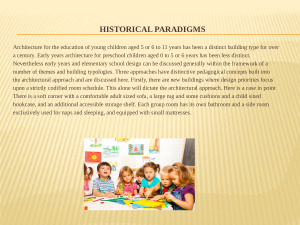
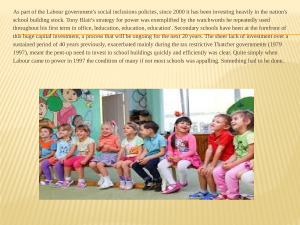
number of themes and building typologies. Three approaches have distinctive pedagogical concepts built into the architectural approach and are discussed here. Firstly, there are new buildings where design priorities focus upon a strictly codified room schedule. This alone will dictate the architectural approach. Here is a case in point There is a soft corner with a comfortable adult sized sofa, a large rug and some cushions and a child sized bookcase, and an additional accessible storage shelf. Each group room has its own bathroom and a side room exclusively used for naps and sleeping, and equipped with small mattresses.
Mūsų mokslo darbų bazėje yra daugybė įvairių mokslo darbų, todėl tikrai atrasi sau tinkamą!

Svetainė naudinga. Visada galima rasti medžiagos ir pritaikyti rašant darbus.

Platus pasirinkimas, didelė pagalba mokantiems ir besimokantiems, leidžia sutaupyti laiką ir pasisemti naujų idėjų. Ačiū

Labai gera svetainė,kai nėra idėjų referatui ši svetainė labai padeda.

Gali rasti naudingos medžiagos. Reikalui esant ją persitvarkyti pagal save. Ačiū

Ačiū, kad esat.Didelis pasirinkimas. Mielai naudojuosi. Labai susitaupo laikas.

Puiki svetainė, gerai, kad yra iš kur pasisemti pavyzdžių, kai galva jau nebeveikia :)