Hygienic equipment design
Detali informacija
Ištrauka
DEPARTMENT OF FOOD TECHNOLOGY
English self study work
Hygienic equipment design
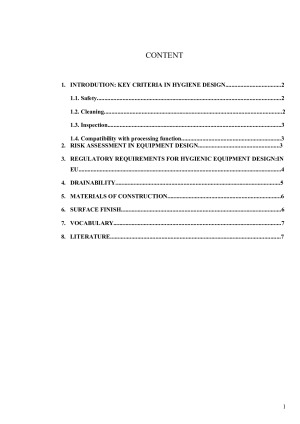
CONTENT
1.INTRODUTION: KEY CRITERIA IN HYGIENE DESIGN 2
1.1. Safety 2
1.2. Cleaning 2
1.3. Inspection 3
1.4. Compatibility with processing function 3
2.RISK ASSESSMENT IN EQUIPMENT DESIGN 3
3.REGULATORY REQUIREMENTS FOR HYGIENIC EQUIPMENT DESIGN:IN EU 4
4.DRAINABILITY 5
5.MATERIALS OF CONSTRUCTION 6
6.SURFACE FINISH 6
7.VOCABULARY 7
8.LITERATURE 7
INTRODUTION: KEY CRITERIA IN HYGIENE DESIGN
The purpose of hygienic equipment design is to:
Give maximum protection to the product
Provide product contant surfaces necessary for processing which will not contaminate the
product and are readily cleanable
Provide junctures which minimise “dead“ areas where chemical or microbial contamination may occur.
Give access for cleaning, maintenance and inspection.
Food contact areas include all surfaces that are directly exposed to the product and all indirect
surfaces from which splashed product, condensate, liquid or dust may drain, drop or be drawn into
the product. This means that, in the hygienic design of equipment for open processing, the area
above the product processing surface must also be taken into consideration.
Safety
Good hygienic design prevents the contamination of the product with substances that would
adversely affect the health of the consumer. Such contamination might be microbiological (e.g.
pathogens), chemical (e.g. lubricanting fluids, cleaning chemicals) and physical (e.g. glass). There
have been many examples of product recalls, lost production and even site closure due to
contamination arising from poorly designed equipment. Physical foreign body contaminants, such
as pieces of plastic, affect the wholesomeness of food but rarely receive media attention. Physical
contaminants a more serious nature, e.g. glass fragments or caustic CIP fluids, however, are much
more serious. Perhaps of most concern are pathogenic microorganisms such as Listeria or
Escherichia coli, which may be harboured in equipment and then subsequently grow during
production and contaminate the product. Under favourable conditions such microorganisms grow
very rapidly. Consequently gaps andcrevices, where microorganisms can harbour and multiply,
must be avoided. Good hygienic design also maintains product in the main product flow. This
ensures that product is not „held-up“ within the equipment where it could deteriorate, affect product
quality on rejoining the main product flow, and encourage the growth of spoilage and pathogenic bacteria.
Mūsų mokslo darbų bazėje yra daugybė įvairių mokslo darbų, todėl tikrai atrasi sau tinkamą!

Svetainė naudinga. Visada galima rasti medžiagos ir pritaikyti rašant darbus.

Platus pasirinkimas, didelė pagalba mokantiems ir besimokantiems, leidžia sutaupyti laiką ir pasisemti naujų idėjų. Ačiū

Labai gera svetainė,kai nėra idėjų referatui ši svetainė labai padeda.

Gali rasti naudingos medžiagos. Reikalui esant ją persitvarkyti pagal save. Ačiū

Ačiū, kad esat.Didelis pasirinkimas. Mielai naudojuosi. Labai susitaupo laikas.

Puiki svetainė, gerai, kad yra iš kur pasisemti pavyzdžių, kai galva jau nebeveikia :)